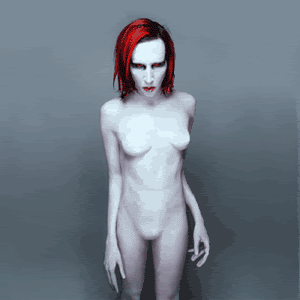
Looking through the history of the feminist / post feminist and more particularly in the view of the art has been based in the feminist critic about: the pornography, claimed for a multiple and fictional identity, the sexuality and the transgender, the cyber feminism; creating all the key point high controversy. Having for principal objective of the sameness.
Focusing in the area of the gender/sex there is a lot of artists that have been working for over 25 years, and been considered and labeled like post feminist. We could ask ourselves if the Deleuez´s dream had become real or if only an illusion, are we really now the expression of “body without organs” (1). In a world of post human identities, post human bodies, are the place in which throughout the 90´s artists works to talk the same dysfunction of the body and the difficulty of construction or representation of an identity.
Those works related to the standard representation, and radical subversion of the image in the way to think about the artistic like a liberated surface, an expression of these machines of the never end ended desire. Analyzing a whole series of art works that play around the idea of free movement identities and sexualities. Like the artwork of Zoe Leonard “Jenniffer Mille “ 1995 could be a good example of the kind of celebration of multiple and ambiguous identity.
Or we could mention the kind of works that try to destroy the classic stereotypes related with the female identity adding elements usually associated to the masculinity (like the beard and hair) in art works like “La femme at le barbu” (1975) by Annette Messager or the famous Janna Sterbak´s hairy shirt. With big doses of irony and humor we can be mention the “Women with Beards” net project that represented fictionally how will be in the year 2000 with bear sexy women photographs, trying to express that the identity are beyond any established category.
The problem with all those works is the confusion that can be generated in the aspect of the gender. Excessively in all those works and in the major cases when it's debated the gender, the discourse tend to address and focus in the surface aspect, in the constructions of visual elements. I will not extend to put more example of artist like Cindy Sherman or Yasumasa Morimura (between a lot of others), because I talked about it in my first essay.
My last proposal could become quite confused in that way, and could follow the same that lacks of those other art works. Having a result in an image that could result diffused.
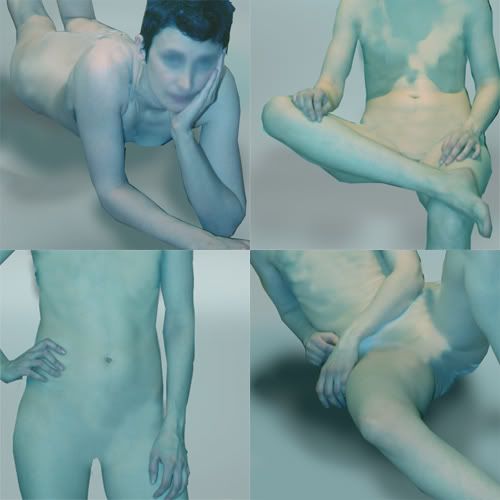
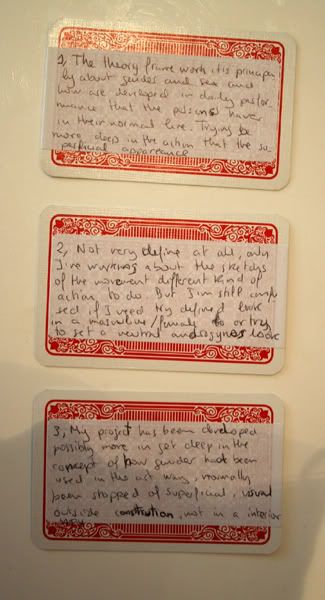
That is the reason that I wanted to base the clips of the videos in the narration of daily performances, daily gestures that everybody can reflect in their own life. The reiteration actions that usually we don't realize. I feel this will be the best way to express that gender is not something that we can wear, it's not an option that we can have opening a wardrobe. Trying to get deeper in the way to show more than only the visual exterior.
Related to this we could debate "What is Female Imagery?" Like Lucy R. Lippard was asked twenty years ago (2) With this apparently innocent question a controversial debate began something that still today stays alive and that it has given rise to interminable exhibitions of women on the feminine thing and its hypothetical readings. The first answer to the question gives L. Nochlin with an opinion that would foretell present positions: "My first reaction is of rage by the restrictive thing of the term. I am a human being, not defined by previous conceptions, androgynous, not programmed to illuminate no imagery specific. But my second reaction is the one to deliver an attack and to meditate it. Alive in a society, and who I am I it comes determined by the existential structure that one assumes a woman to him. My experience is filtered through a complex interaction between myself and the expectations that the world has about me". In this answer pointed an interaction between the individual experience and the surroundings and through her the question were answered intelligently. The individual experience very hardly can separate of inherited cultural products; the social and personal situation of the artists influences manifest in its work and, after the appearance of the feminism, no longer we can maintain the existence of an innocent glance. But it does not necessarily bring with himself a glance of coherent, predictable and a universal group or either the assumption of a non-temporal collective glance. As Judith Butler (3) would point out seventeen years later: perhaps "If a notion of a stable sort let it be like the original premise of the feminism policy, it will be necessary a new type of feminists policy that responds to the objectives of gender and identity; a policy that assumes the variable construction of the identity like methodological requirement as much normative, when not like a politic objective "
One of the obvious problems that the first feminists had to confront with the gender was trying to find a female imagery using the opposition of the masculinity. The gender considered then as a social construction whose fluctuation possible in the historical happening and that is in constant negotiation from the same moment at which its perennially begins to be questioned.
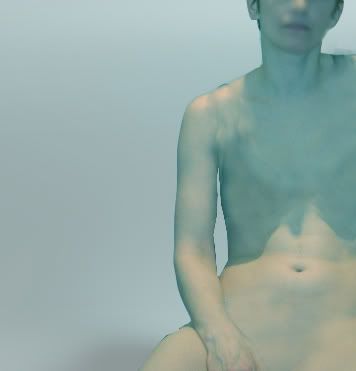
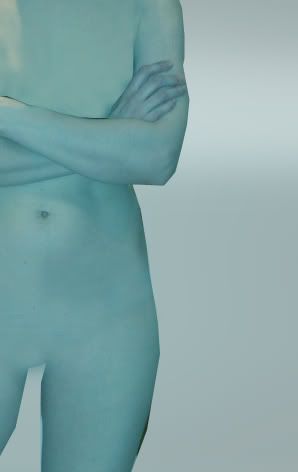
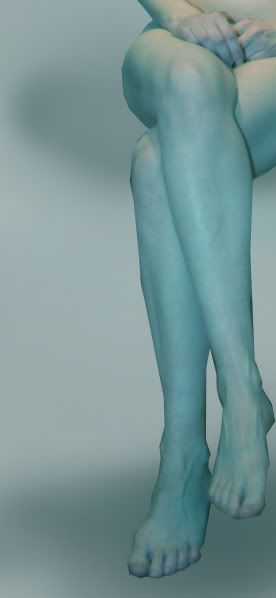
Principally to express my idea of multiplicity and the whole universe of possibilities that a person can have to project his/her gender I decided take a model that performances a diverse example of those ordinary actions. I found more appropriated that have different model to performances different types of option, because metaphorically articulate that there no limitation respect in both sex and how stupid can be associated determinates gestures to one or other sex.
The part of game (slider puzzle) that my proposal will imply can result a very stimulated expression, the idea of discovering in the video motion collage an explosion of possibilities. Trying to get a balance between a piece that can be read in an abstract way but also in a literal version too. Something similar to a puzzle slider is that the audience will sort, although the idea that the audience will contact to the piece by a computer and the image can be project in a wall, could be interesting and using something similar that a joystick to emulate that a idea of game or videogame.
Being a digital piece is the only option, the immersion that the audience could have couldn't be possible in any other way. Leaving the option to choose a composition with the different clips. The result can be a great video motion collage, with the objective of creating a multiplicity of results. The piece can be assumed like a video game without rulers or any specific ending.
The developed narrative, the digital narrative in a multiple senses: producing with number, digits, narratives dissolve in the electronic virtuality. Maybe the greater potential of the computer is its interactive condition; therefore to narrate by means of computer means to explain a history in an interactive form, which implies the possibility of taking part in the history (if that exist). The fundamental challenge of all interactive history consists of solving "the dilemma interactive suitably", that is to say, the necessity to assure the balance between two poles: the control of history on the part of the author and the degree of freedom of the audience have. Not to be sequential is an other issue when it's a digital narrative, to do a effect piece we need to put in the mind that an art work can be read in any moment because it's not a long time that audience take to look at a piece.
The new proposal does not lose the key point that I had initially discussed about confronting the watcher / user to take an active part in that issue. Now they are not integrating themselves in the piece but they add their own solution or their own choice of construction. Using a model becomes the best option in the way that I can do the research to study, explore and analyze an extensive amount of different ways to do those daily performances. Researching from different media like films, TV, publicity, and as well to study people in public and private spaces
(1) Deleuze, Gilles and Félix Guattari. , 1987 A Thousand Plateaus: Capitalism and Schizophrenia. Trans. Brian Massumi. Minneapolis: The University of Minnesota Press.
(2) Lippard, L,R. 1976 What is Female Imagery?.Feminist essays on women´s art. New York :Dutton.
(3)Butler , Judith. 1990. Gender trouble: feminism and the subversion of identity. New York: Routledge
+17:50+%232.jpg)