Friday, September 30, 2005

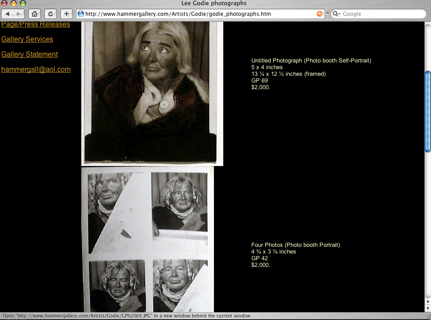
References about other artist that had been used the photo booth

Image hosted by Photobucket.com

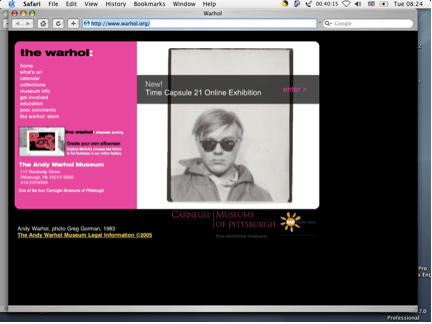
http://www.warhol.org/

Image hosted by Photobucket.com


Image hosted by Photobucket.com


Image hosted by Photobucket.com

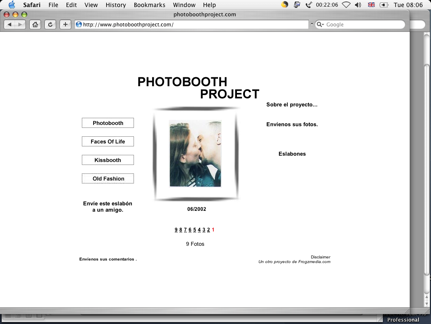
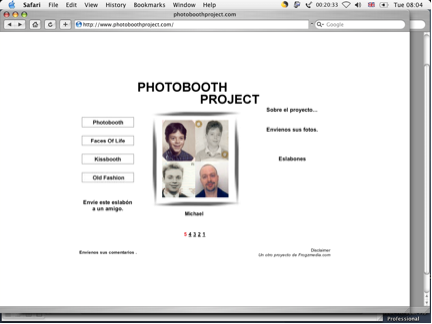
http://www.photoboothproject.com/


Image hosted by Photobucket.com


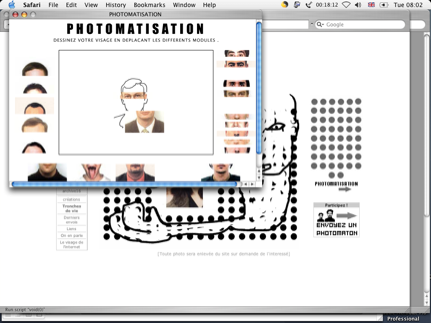
http://photomatisme.free.fr/photomaton3.html


Image hosted by Photobucket.com


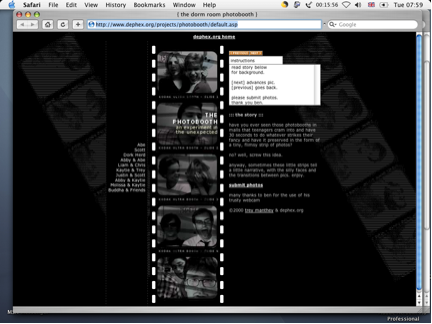
http://www.dephex.org/projects/photobooth/default.asp


Image hosted by Photobucket.com


Image hosted by Photobucket.com


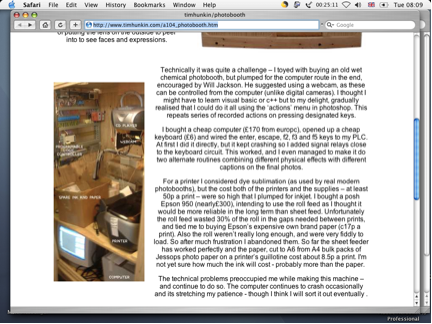
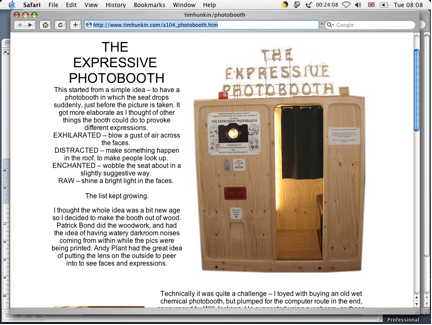
http://www.timhunkin.com/a104_photobooth.htm


Image hosted by Photobucket.com

Wednesday, September 28, 2005

Interactivity in the Digital Art

Interactivity in Digital Art

If we spoke of interactivity in the art and we want to look for the origins, can be result contradictory. Duchamp usually said that any piece of art to be read needs a process of creativity to be decoded, for this reason we could say that any art piece it’s interactive.

We continued investigating in the interactivity of the media them we were with find Bertold Brecht and his developed around the radio ("to change this apparatus of the distribution to comunicación"(1), a use differentiated from the television with the same intention to dissolve to the dichotomy receiving-producer, trusting the potentials emancipates of not hierarchies systems of communication. Another initial point we could find in fluxus when they began to use happening and performance to question the relation that the audience have with the art, speaking about the object and the lost of this. Also they dealed with the subject of the communication and for it, they theorized about the new mass media that appeared like the television. In them, this machine of images lost its customary invisibility, calling the attention on its physical presence and materiality as concrete device. Simultaneous negation, therefore, of the visibility of the image and the invisibility of the apparatus. The multiple delays of the spectator and their unquestionable desire of disappearance no longer here are satiated by the succession of visual moments and vertiginous ruptures chained to a continuity of sequences and fast transitions.
A point to emphasize on the interactivity is the make to give an opportunity to the implication/participation hearing in the art piece. The process of the piece has a part of participation of the audience not being the author of the piece the person in charge that deciphers and disturbs the complete route of the piece.

One of the big problems than we found, is the location of these pieces; normally arranged in galleries, museums, institutions, ect... where the tradition of "look but do not touch" is very latent over the audience, where these act shyly or simply don’t act by fear not to commit something that it’s not allow.

But I find asking myself, Does exist this really interactivity? For example an affluent fact known that is the button "To close the door" in many elevators is placebo without utility, ready in the place to only give to the individuals the impression that they participate in some way, contributing to the rapidity of the day of the elevator when we pushed that button, the door is closed exactly at the same time that when we pushed the button that indicates the floor without "worrying" the process by the fact to also push the button of "closing the door". This extreme case of false participation is an appropriate metaphor of the participation of the individuals in our "postmodern" political process... Of course, the postmodern answer to this would be that the radical antagonism only emerges, as the society even is perceived like totality, as Adorno said that contradiction is difference under the identity aspect. So that the idea is that with the postmodern era, the backward movement of the identity of the society involves simultaneously the backward movement of antagonism, dividing in two parts the social body what we received in exchange for this is one person of the indifference like the neutral means in which the multitude (of life styles, etc.) it coexists. Then, What it’s the point for the artist does not mediating to the audience in its work? Is not perhaps an interactive piece a masked closed route? Does really exist the interactivity? For me I would only talk about the interactivity when the act of the art it’s a way of visibility or make become aware about a subject. Other good example will be talk about the hackactivism when they proposed some flood net to get something for the better status of a community, to me it’s a real act of interactivity.


And after all the massive part of the artistic projects more assets in the field of the critical reflection on the use of mass media of masses been has based on the belief in that it is possible to solve many of the present problems of the society through different a public communication. For that reason we find its insistence in the attempt to produce means, surroundings of opinion interchange and language, giving then a production of new forms of critical community through them.

Thursday, September 22, 2005

Distance and Aura

I liked the idea of use this title for my blog, about the idea of virtual, the lost of the object. Like Lev Manovich used for his text title. It seems to me a subject with much controversy that the art has found some time before and if we want to speak on digital art is essential.

We could start asking ourselves as Manoovich does, what is the human nature and what it is the technology? How can be delineated in the heat of the limit between both in century twenty? He explain analyzing Benjamin and Virilio, that they solve this problem in the same way. Both consider related nature and distance in space between the observer and the observed one; and they see the technologies like destroyers of the distance. As we see these two suppositions take to them to very interpret the new excellent technologies of their times of a similar way.

Benjamin begins now with that famous concept of aura: the unique presence of a work of art, an historical or natural object. We could think that an object must be near if we want to experience its aura but, paradoxically, Benjamin defines - in the work already mentioned aura "like the only phenomenon of a distance": "if while you rest in late of summer you follow with the glance the extension of mountains in the horizon or a branch that project their shade on you, experience the aura of those mountains and that branch". Similar, Benjamin writes, "the painter maintains in its work a natural distance of the reality". That respect by the distance common in both, perception of the nature and painting, is upset by the new technologies of reproduction of masses, specially the photography and the cinema. The camera, to Benjamin compares with a surgeon, "deeply penetrates in its weave [ of reality ]"; its camera focuses for "evoking to an object by its shell"

Virilio introduces the term "Small Optics" and "Big Optics", to emphasize the dramatic nature of this change. The Small Optics is based on the geometric perspective and shared by the human vision, the painting and the cinema. This implies to the distinctions between close and far, an object and a horizon on which the objects excel. The Big Optics occurs in the real time of electronic transmission of information, is "the active optics of time happening to the speed of light".

If the information from any place can be transmitted with the same rapidity, the fence concepts and far, horizon, distance and space will not return to have meaning (Therefore, if for Benjamin the industrial era moved to all the objects of its original place, for Virilio the postindustrial era eliminates the dimension of space completely). At least in principle, each Earth point is now instantaneously accessible from any other point of the planet. As a result of this, the Big Optics locks up in a claustrophobic world without no depth or horizon to us; the Earth becomes ours prison.

In the occidental thought the vision always has been understood and discussed in opposition to the tact; reason why, inevitably, the degradation of the vision (to use the term of Martin Jay) leads to the elevation of the tact .For example, we can be attempted to read the lack of distance characteristic of the tactile act like concession for a different relation between the subject and the object. Benjamin and Virilio block this line of apparently logical discussion when they express the potentially present aggression in this act. More than the tact of the understanding like a respectful and careful contact or a caress, they present/display like a breakage of arguments informal and aggressive.

This way about the connotations standard of vision and tact happen opposite for Benjamin and Virilio the distance guaranteed by the vision preserves the dawn of an object, its position in the world, whereas desire "to approach the things destroys the relations between the objects, finally eliminating the material order the complete one and leaving without meaning the slight knowledge of distance and space. Therefore, and if we are in discord with its reflections on the new technologies and even questioned its positioning in favor of the conservation of the natural order and the distance, the critic on the vision-tact is something that we would have to retain.

The bibliography of this text are mostly based in the Das Kunstwerk im Zeitalter seiner technischen Reproduzierbarkeit (The Work of Art in the Age of Mechanical Reproduction by Benjamin in 1936 and Big Optics, by Paul Virilio.

Tuesday, September 20, 2005

Welcome to Distance and Aura